

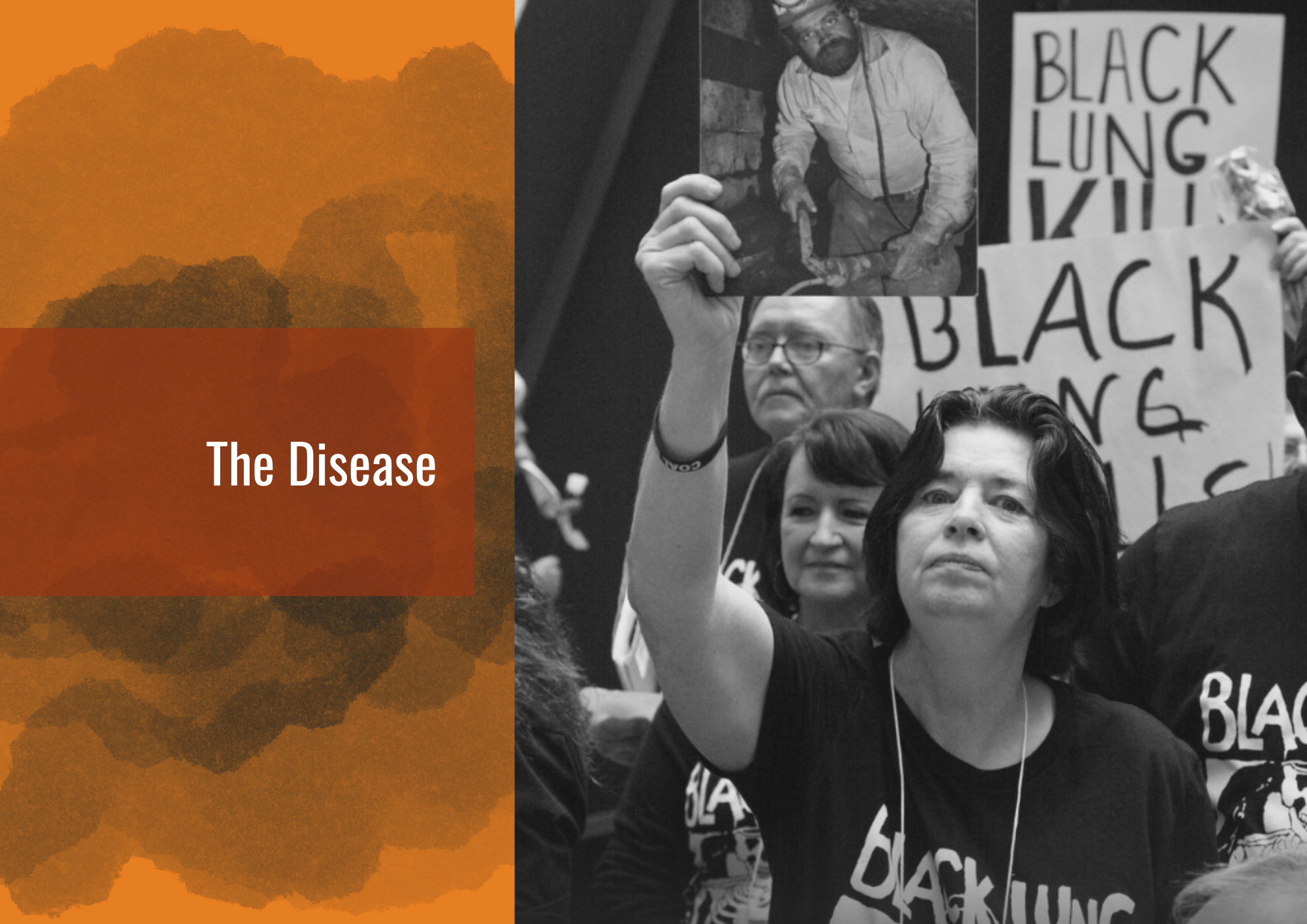
Photo Credit: Earl Dotter
What is Coal Workers’ Pneumoconiosis?
The Difference Between CWP and Progressive Massive Fibrosis (PMF)
Coal Dust
Coal dust particles come from the coal seam itself during mining activities. While harmful over long periods of intense exposure, coal dust typically causes the slower-developing forms of CWP when exposure limits are exceeded or dust controls fail.
Silica Dust
Crystalline silica is a mineral commonly found in rock layers surrounding coal seams. When mining equipment cuts through silica-rich environments, it can release the extremely fine silica particles into the air. Silica dust is much more toxic to lung tissues than coal dust. When inhaled, silica particles can cause intense inflammation and rapid scarring, leading to more severe and aggressive forms of lung disease.
Preventing Black Lung at Work
Coal Workers’ Pneumoconiosis (CWP), commonly known as black lung disease, is a serious and preventable occupational lung disease caused by the inhalation of coal or silica dust. When miners breathe in coal and silica dust particles, the dust can accumulate deep within the lungs. The body’s attempts to remove these particles causes inflammation and scarring in lung tissue, which gradually reduces the lungs’ ability to function.
Miners with black lung disease may experience symptoms such as shortness of breath, chronic cough, chest tightness, fatigue, and reduced ability to perform physical activity. Black lung disease can be permanently disabling and may lead to premature death.
Although the disease is entirely preventable through effective dust control and monitoring, rates of occurrence have risen in recent years, particularly in parts of the Appalachian coalfields of Kentucky, Virginia, and West Virginia.
Coal Workers’ Pneumoconiosis (CWP) is a dust-related lung disease that is caused by inhaling coal mine dust including coal and crystalline silica dust. Advanced imaging may show small nodules or areas of scarring in the lungs and symptoms may progress over a period of time. CWP can refer to the broader disease category, including early forms of black lung disease, where PMF is a more advanced and complicated form of the disease.
Progressive Massive Fibrosis (PMF) is the most severe form of black lung disease, also known as “complicated black lung.” PMF occurs when the smaller areas of lung scarring merge into large masses of dense, fibrotic tissue. These large scars severely restrict the lungs’ ability to expand and exchange oxygen, which can lead to a worsening shortness of breath, reduced lung functions, and more disabling diseases.
Coal Dust vs. Silica Dust: Why the Disease is Increasing
CWP is entirely preventable when proper dust controls are in place. Prevention strategies include improved mine ventilation, effective dust suppression systems, continuous dust monitoring, and strong enforcement of exposure limits.
Research and health monitoring programs conducted by agencies such as the National Institute for Occupational Safety and Health (NIOSH) and worker safety oversight by the Mine Safety and Health Administration (MSHA) continue to play a critical role in identifying emerging risks and protecting coal miners from this occupational disease.
How Black Lung Disease is Diagnosed
Diagnosing black lung disease involves a combination of medical evaluation, occupational history, and specialized testing. Because the disease develops gradually, miners may not experience symptoms until lung damage has already occurred.
There is no single test that diagnoses every type of black lung disease. A diagnosis is based on the whole picture, including a miner’s work history, symptoms, physical exam, imaging tests, and pulmonary function testing.
Some may think of black lung only as coal workers’ pneumoconiosis (CWP), which may show up as spots, nodules, or scarring on a chest X-ray. However, breathing coal mine dust can cause several different types of lung disease. Some miners may have serious breathing problems even when a chest X-ray does not show classic signs of pneumoconiosis.
Coal mine dust exposure can contribute to:
Chronic obstructive pulmonary disease (COPD): This includes chronic bronchitis and emphysema. COPD can cause cough, mucus production, wheezing, chest tightness, and shortness of breath.
Pulmonary fibrosis: This means scarring of the lungs. In miners, this may sometimes be described as dust-related diffuse fibrosis.
Pneumoconiosis: This includes coal workers’ pneumoconiosis and silicosis. These diseases are caused by inhaling dust particles that can lead to lung inflammation, nodules, and scarring over time.
Because these conditions can also have other causes, simply having COPD, pulmonary fibrosis, or pneumoconiosis does not always mean the disease was caused by coal mine dust. A medical provider must carefully review the miner’s occupational history, exposure history, symptoms, imaging results, and breathing test results.
A normal X-ray does not always rule out disease
A chest X-ray is an important tool in evaluating black lung disease, but it does not tell the whole story. Some miners may have symptoms or abnormal breathing tests even when imaging findings are subtle or when a chest X-ray appears normal.
This is one reason pulmonary function testing is so important. These breathing tests help to measure how well the lungs are working and how much a lung condition may be affecting a person’s ability to breathe. Pulmonary function testing may help a medical provider to identify lung damage that is not obvious on imaging alone.
Tests that may be used
Your healthcare provider may recommend one or more of the following:
Occupational and exposure history: Your provider will ask you about your mining work, job duties, years worked, type of mine, dust exposure, use of respiratory protection, and whether you had exposure to coal dust, silica dust, or other workplace irritants.
Symptom review and physical exam: Your provider will ask you about your symptoms, such as cough, mucus production, shortness of breath, wheezing, chest tightness, and whether these symptoms occur during activity or at rest.
Chest X-ray: A chest X-ray can show findings that may be consistent with coal workers’ pneumoconiosis or other lung disease. Some X-rays may be reviewed by specially trained physicians called B Readers.
Pulmonary function testing: These tests measure how much air you can breathe in and out, how quickly you can move air, and how well your lungs are working. They help determine the level of breathing impairment.
CT scan: A CT scan can provide more detailed pictures of the lungs than a chest X-ray. However, CT scans are not always required. Many cases of black lung disease can be diagnosed using a combination of work history, symptoms, pulmonary function testing, and chest X-ray findings.
Additional testing: In some cases, your provider may recommend blood oxygen testing, exercise testing, or other evaluations to better understand how your lungs are functioning.
Different doctors may read imaging differently
Sometimes miners receive different opinions about whether pneumoconiosis is present. For example, one B Reader may interpret a chest X-ray as showing findings consistent with coal workers’ pneumoconiosis, while another may not.
This can be frustrating, but it can happen because interpreting imaging studies involves professional judgment, especially in early or borderline cases. For this reason, the diagnosis of coal mine dust-related lung disease should not be based on one test result alone. It should be based on the totality of the evidence.
Lung biopsies for diagnosis
A lung biopsy is rarely needed to diagnose pneumoconiosis. However, in selected cases, a biopsy may be helpful if the diagnosis is uncertain or if there is concern for another condition, such as lung cancer.
Disease may progress after exposure ends
Black lung disease and other coal mine dust-related lung diseases may continue to affect a miner’s breathing even after dust exposure ends. Some conditions may progress over time. This is why early evaluation, regular follow-up, and avoiding further dust exposure are important.
If you are a current or former coal miner and have symptoms such as cough, shortness of breath, chest tightness, wheezing, or mucus production, talk with a healthcare provider familiar with occupational lung disease. A comprehensive evaluation can help determine what type of lung disease is present, how much it is affecting your breathing, and whether it may be related to coal mine dust exposure.
Programs like the Coal Workers’ Health Surveillance Program (CWHSP) offer free periodic screenings, allowing early detection and the option to transfer to lower-dust jobs if disease is found.
Is there a free NIOSH black lung screening in your area? Check out the NIOSH website here.